 Steady
Results
Intermittent fasting results: what changes, and when
The first three days are water. The most useful changes never show up on a scale at all. Here is the honest order things happen in.
Most people judge intermittent fasting on the wrong measurement at the wrong time. They weigh themselves on day three, see a drop, and conclude it is working. Then they weigh themselves on day twenty, see the same number as day ten, and conclude it stopped working. Neither reading meant anything. The scale is simply the loudest instrument in the house, so it gets listened to.
The honest timeline
When each thing actually changes
Typical on a steady 16:8 schedule. Individual timing varies, but the order rarely does.
Days one to four: that is water
Your body keeps a small store of carbohydrate in the muscles and liver, and it holds roughly three grams of water for every gram of that store. Eat less for a few days, draw the store down, and the water leaves with it. That is the fast two to four pounds nearly everyone reports in the first week, and it is the reason fasting has a reputation for dramatic early results.
It is also the reason the second week feels like failure. Nothing has gone wrong. The water is simply gone and what remains is the slow part, which was always going to be the slow part.
Weeks one and two: hunger changes shift
This is the first genuine result and almost nobody counts it. Hunger largely follows the times you have taught your body to expect food. Move the times, and for a week or two it keeps asking at the old ones, sharply, and then gives up and asks at the new ones instead.
When that switch happens, the whole thing gets easier in a way that has nothing to do with willpower. If you quit in week one, this is the change you quit two days before.
Weeks two to four: the hard stretch gets shallower
Every fast has one stretch that is worse than the rest — usually the last couple of hours before the window opens, when tiredness, hunger and a flat mood arrive together. It does not disappear. It gets shallower, and it stops being a surprise, which turns out to matter more.
This is the result worth tracking, because it is the one that predicts whether you are still doing this in three months. A scale cannot see it. Rating how you feel when it is bad, and again two hours later, can.
Weeks four to eight: now the scale can say something
Trials of time-restricted eating mostly land between about one and four percent of body weight over two to three months. That is real and worth having, and it is a long way from the before-and-after photos. A month in, a pound or two of actual fat is a normal, successful result.
The trouble is that a scale moves about that much between Tuesday and Wednesday for reasons that have nothing to do with fat: salt, sleep, hydration, what is still in your gut, time of the month. Here is eight weeks of a real, working fat loss trend drawn underneath the daily weigh-ins that produced it.
Eight weeks of weighing yourself every day
A genuine downward trend, and the daily numbers it actually shows up as.
Weight
What it does not do
It does not target belly fat, or any other single place. It does not raise your metabolism in a way that lets the arithmetic go. It does not make calories stop counting inside the window, which is the single most common reason people report no results at all: the window shrank and the meals grew to fill it.
And there is no threshold hour where something magic starts. Sixteen is a round number, not a switch. The window you keep outperforms the window that sounds most impressive, every time.
Three numbers worth keeping
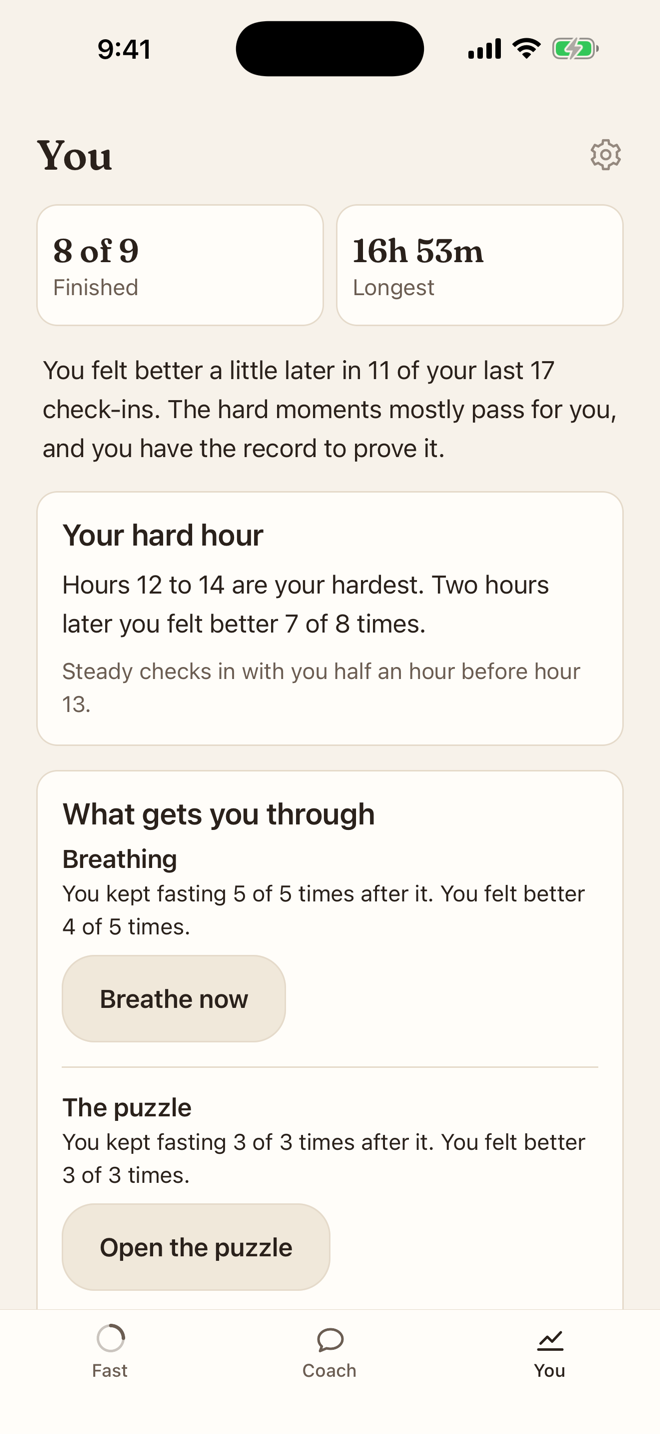
If you keep anything, keep these. They are answerable within two weeks, they do not lie the way a daily weight does, and together they tell you whether to continue, adjust or stop.
- Fasts finished out of fasts started. Seven out of ten is a schedule that fits your life. Two out of ten is a window that needs two hours taken off it.
- Which hours are hardest, for you. Not for people in general. Once you know yours, you can plan for one stretch instead of dreading the whole day.
- Whether the bad feeling passed. Rated when it was bad, and again two hours later. After a few fasts this stops being reassurance and becomes evidence.
When to decide it is not working
Give it eight weeks, then ask two questions rather than one. Did the way you eat across the whole week actually change? And is the schedule something you can picture doing in March?
If the answer to the first is no, fasting was never tested; the window existed but the eating did not change, and that is fixable. If the answer to the second is no, stop. A fasting window is one way of eating a bit less, not the only one, and nothing is lost by using a different one. It is a tool, not a test of character.
Questions people ask
How long does it take to see results from intermittent fasting?
Appetite usually settles into the new meal times within one to two weeks, and that is the first real result. Weight change, if any, becomes readable after about four weeks and clear by eight. The drop in the first three days is water, not fat, and it comes back the first time you eat normally.
How much weight can you lose with intermittent fasting in a month?
Trials of time-restricted eating usually land between about one and four percent of body weight over two to three months, so a month in, a realistic figure is small: a pound or two of actual fat for many people. Anyone promising ten pounds in a month is describing water, an unusually large calorie cut, or nothing.
Why am I not losing weight with intermittent fasting?
Almost always because the eating window did not change how much you ate across the week. A shorter window helps by removing eating opportunities, and it stops helping if the meals inside it grow to fill the gap. The second most common reason is judging four weeks of progress on a scale that moves two pounds a day on its own.
Does intermittent fasting burn belly fat specifically?
No. Nothing targets fat in one place, including fasting. Fat comes off across the body in an order set largely by genetics, and where you notice it first is not something a schedule can change. Fasting helps some people eat less overall, and that is the whole mechanism.
Is a week long enough to tell whether intermittent fasting is working?
For weight, no. For whether it fits your life, yes, and that is the more useful question. After one week you already know whether you can finish the fasts you start, which predicts everything that follows better than the scale does.
Less app. Better fasts.
Steady is a simple fasting app for iPhone: a timer for 12 to 20 hour windows, one check-in at the hour that matters, and a record that tells the truth. No account, no streak to lose, nothing leaves your phone.
Free while it is in beta. Tell us what breaks, and we will let you know when Steady reaches the App Store.